Satria Rezki Fernanda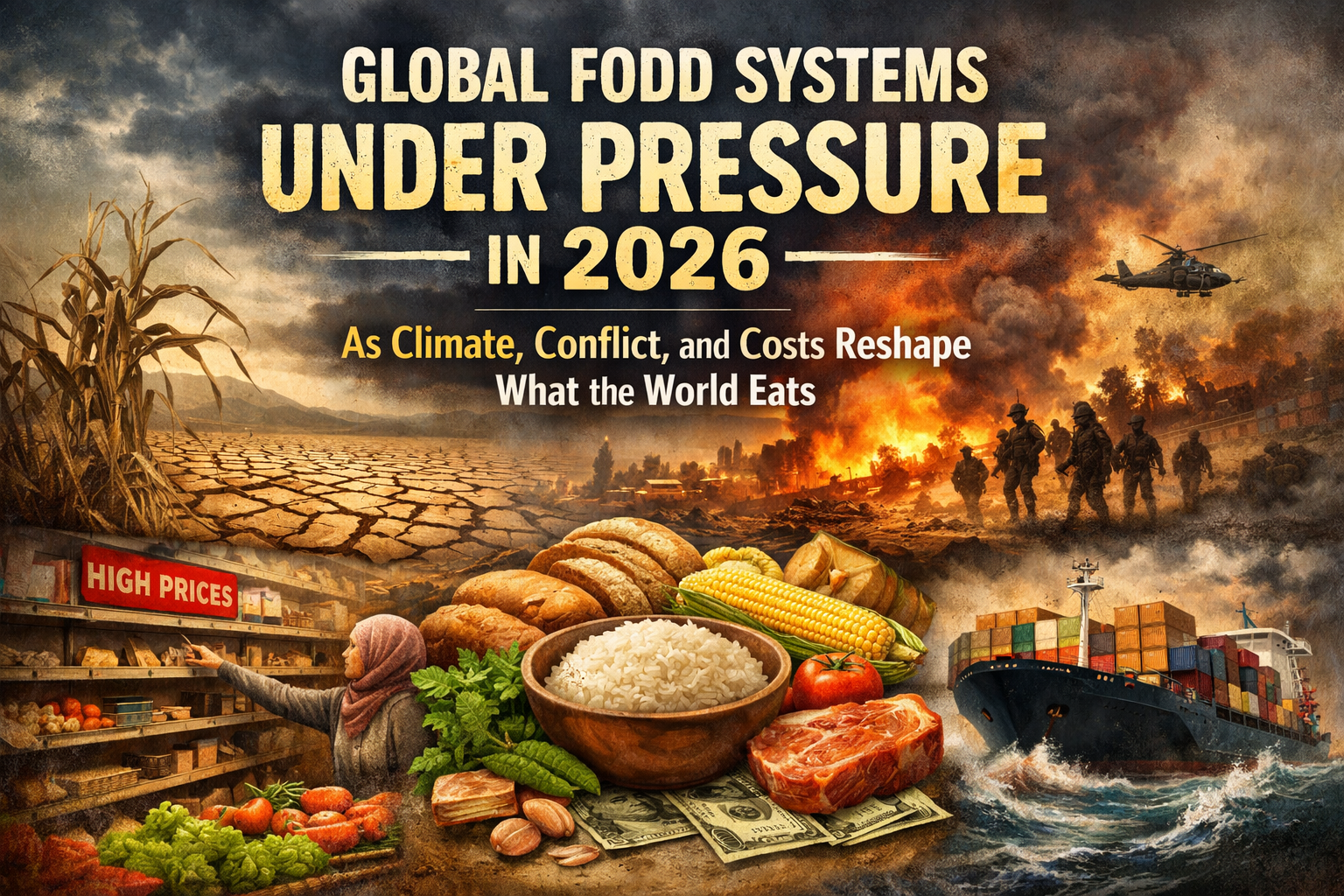
Global food systems are facing renewed strain in early 2026, as climate disruption, geopolitical instability, and rising production costs converge to challenge food security in many parts of the world. Governments, farmers, and international organizations warn that while outright global shortages are not imminent, access to affordable and nutritious food is becoming increasingly uneven, particularly for low-income populations and import-dependent countries.
Extreme weather remains a central driver of concern. Prolonged droughts, unpredictable rainfall, and heatwaves have affected harvests across multiple regions, disrupting staple crop production. Agricultural experts report that climate variability is making traditional planting calendars less reliable, forcing farmers to adapt quickly or face declining yields. In some regions, floods have destroyed crops just weeks before harvest, compounding losses from earlier dry spells.
Major food-producing countries are also feeling the pressure. While large exporters continue to supply global markets, output fluctuations have contributed to price volatility. Wheat, rice, and corn prices have shown sharp swings in recent months, reflecting uncertainty around future harvests. Analysts note that even modest disruptions in key producing regions can have outsized effects on global markets due to tightly interconnected supply chains.
Geopolitical tensions further complicate the picture. Conflicts and trade disputes have disrupted agricultural exports and fertilizer supplies, raising costs for farmers worldwide. Fertilizer prices, although lower than their peak levels in previous years, remain elevated compared to historical averages. This has forced some farmers to reduce usage, potentially affecting yields and long-term soil health. Import-dependent countries are particularly vulnerable, as higher input costs translate into higher food prices for consumers.
In response, governments are revisiting food security strategies. Several countries are expanding strategic grain reserves and offering subsidies to stabilize domestic markets. Others are investing in domestic production to reduce reliance on imports, even where natural conditions make farming challenging. Policymakers argue that recent global shocks have exposed the risks of overdependence on international supply chains for essential goods.
Technological innovation is increasingly seen as part of the solution. Precision agriculture, drought-resistant seeds, and data-driven farming practices are being promoted to improve efficiency and resilience. Agritech companies report growing interest in tools that help farmers optimize water use, monitor soil conditions, and predict weather-related risks. However, access to such technologies remains uneven, particularly in developing regions where capital and infrastructure are limited.
Smallholder farmers, who produce a significant share of the world’s food, face disproportionate challenges. Rising costs, limited access to credit, and exposure to climate risks threaten livelihoods and local food availability. Development agencies stress that supporting small-scale agriculture is essential not only for food security but also for poverty reduction and rural stability. Programs focused on training, microfinance, and cooperative models are gaining renewed attention.
Urban populations are also feeling the impact. Higher food prices have strained household budgets, particularly in cities where residents rely almost entirely on purchased food. In some countries, governments have expanded food assistance programs or imposed temporary price controls to protect consumers. Economists caution, however, that such measures must be carefully designed to avoid distorting markets or discouraging production.
Dietary patterns are beginning to shift as well. Nutrition experts observe that when food prices rise, households often reduce consumption of fruits, vegetables, and protein-rich foods, turning instead to cheaper, calorie-dense options. This trend raises concerns about long-term public health outcomes, particularly among children. International health organizations warn that food insecurity is not only about quantity, but also about the quality and diversity of diets.
Climate adaptation in agriculture is becoming a priority topic in global forums. Countries are sharing best practices on water management, crop diversification, and early warning systems for extreme weather. There is growing recognition that adaptation must be locally tailored, as climate impacts vary widely by region. Researchers emphasize that traditional knowledge, combined with modern science, can play a key role in building resilient food systems.
The role of international institutions is also under scrutiny. Organizations such as the Food and Agriculture Organization are calling for stronger coordination between governments, donors, and the private sector. They argue that fragmented responses risk leaving the most vulnerable populations behind. Long-term investment, rather than short-term crisis response, is increasingly framed as essential.
At the same time, debates continue over sustainability and environmental impact. Agriculture is both a victim of climate change and a contributor to it, accounting for a significant share of global greenhouse gas emissions. Policymakers face the challenge of increasing food production while reducing environmental harm. Practices such as regenerative agriculture, reduced food waste, and alternative protein sources are gaining attention as potential pathways forward.
Consumer behavior is slowly evolving in response to these pressures. Interest in locally produced food, seasonal diets, and reduced waste is growing in some markets. While such changes alone cannot solve systemic issues, experts say they can contribute to more resilient food systems when combined with supportive policy frameworks.
Looking ahead, analysts warn that food security will remain a defining global issue throughout 2026 and beyond. The convergence of climate risk, economic pressure, and geopolitical uncertainty means that shocks are likely to recur. The question is not whether the global food system will face stress, but how well it can absorb and adapt to it.
Ultimately, ensuring stable access to food will require coordinated action across borders and sectors. From farmers in the field to policymakers in national capitals, decisions made today will shape what food systems look like in the years ahead. In an increasingly uncertain world, the ability to produce, distribute, and afford food may become one of the most critical measures of global resilience.