Satria Rezki Fernanda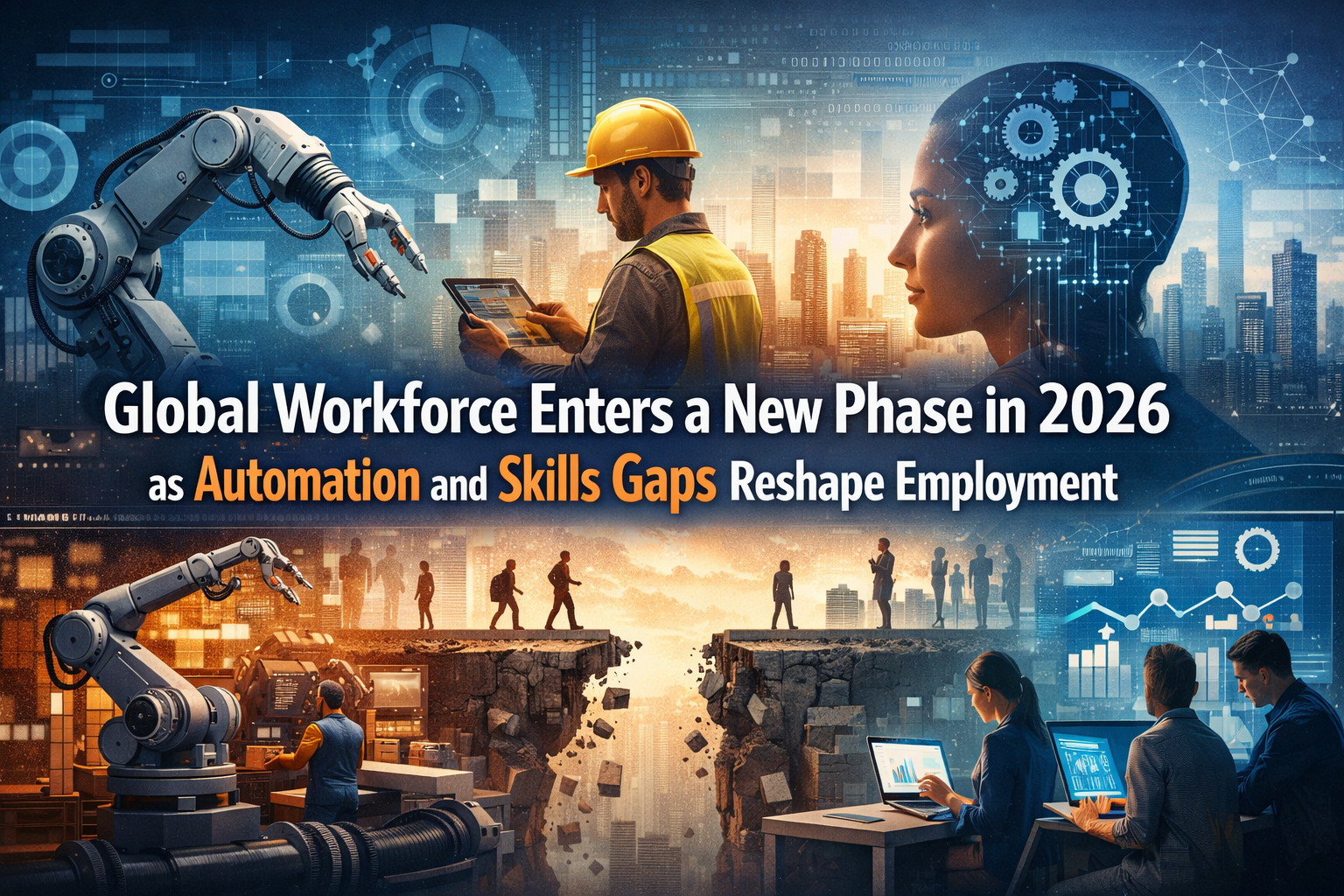
The global workforce is undergoing a profound transformation in 2026, as automation, artificial intelligence, and shifting economic priorities redefine how and where people work. Governments, businesses, and workers alike are adjusting to a labor market increasingly shaped by technology, demographic change, and the demand for new skills, raising urgent questions about job security, education, and long-term economic resilience.
Across advanced economies, employers report growing difficulty filling roles that require specialized technical skills. Positions in data analysis, cybersecurity, engineering, and advanced manufacturing remain in high demand, even as hiring slows in more traditional sectors. Economists describe this as a structural mismatch rather than a cyclical problem, with available jobs and available workers often failing to align in terms of skills.
Automation continues to expand beyond factories into offices and service industries. AI-powered tools are now commonly used for customer support, accounting, content moderation, and logistics planning. While companies emphasize productivity gains and cost efficiency, workers express concern about job displacement and the pace of change. Labor unions warn that without proactive policy responses, automation could widen inequality between high-skilled and low-skilled workers.
In developing economies, the picture is more complex. Manufacturing and service outsourcing still provide employment opportunities, but automation is beginning to limit job growth in sectors once seen as reliable pathways to development. Governments are increasingly focused on upskilling programs and digital literacy initiatives to ensure workers can participate in evolving global value chains.
Remote and hybrid work models, once considered temporary, are now firmly embedded in many industries. Companies report that flexible work arrangements help attract talent and reduce overhead costs, while employees value improved work-life balance. However, disparities remain between workers who can work remotely and those whose jobs require physical presence, such as healthcare staff, construction workers, and service employees.
Youth employment is emerging as a key concern. In several regions, young people face high barriers to entry into stable employment, driven by limited experience requirements and rapid technological change. Employers increasingly prioritize adaptability and continuous learning over formal credentials, challenging traditional education-to-employment pathways. Governments are responding with apprenticeship programs and partnerships between industry and educational institutions.
The role of education systems is under renewed scrutiny. Universities and vocational schools are being urged to update curricula more frequently to reflect labor market needs. Short-term certification programs, online learning platforms, and employer-led training are gaining popularity as alternatives to traditional degrees. Critics caution, however, that rapid credentialing must still ensure quality and long-term relevance.
Workplace culture is also evolving. Employees increasingly expect flexibility, purpose, and mental health support from employers. Surveys indicate that job satisfaction is closely tied to autonomy and opportunities for growth, not just salary. Companies that fail to adapt to these expectations risk higher turnover, particularly among younger workers.
Governments are experimenting with policy responses to manage the transition. Some countries are expanding unemployment benefits, retraining subsidies, and lifelong learning accounts to support workers affected by technological change. Others are debating more radical ideas, such as shorter workweeks or new forms of social protection, to adapt to a future where traditional full-time employment may be less universal.
International organizations warn that global coordination will be critical. Labor markets are increasingly interconnected, with talent mobility, remote hiring, and digital platforms crossing borders. Standards for worker protection, data privacy, and fair competition vary widely, creating challenges for both employers and employees. Calls for updated international labor frameworks are growing.
Despite uncertainty, many experts see opportunity alongside disruption. Automation can eliminate dangerous or repetitive tasks, while new industries create roles that did not exist a decade ago. The challenge lies in ensuring that transitions are inclusive and that workers are not left behind as economies evolve.
Businesses that invest in training and human capital are already seeing benefits, according to labor analysts. Employees with access to continuous learning are more adaptable and productive, helping companies remain competitive in fast-changing markets. This has strengthened the argument that workforce development is not just a social responsibility, but a strategic investment.
As 2026 progresses, the future of work remains one of the most consequential issues facing societies worldwide. Decisions made now — by policymakers, employers, and educators — will shape how millions of people earn a living in the years ahead. Whether the transformation leads to greater opportunity or deeper inequality will depend largely on how well economies manage the balance between technological progress and human potential.