Satria Rezki Fernanda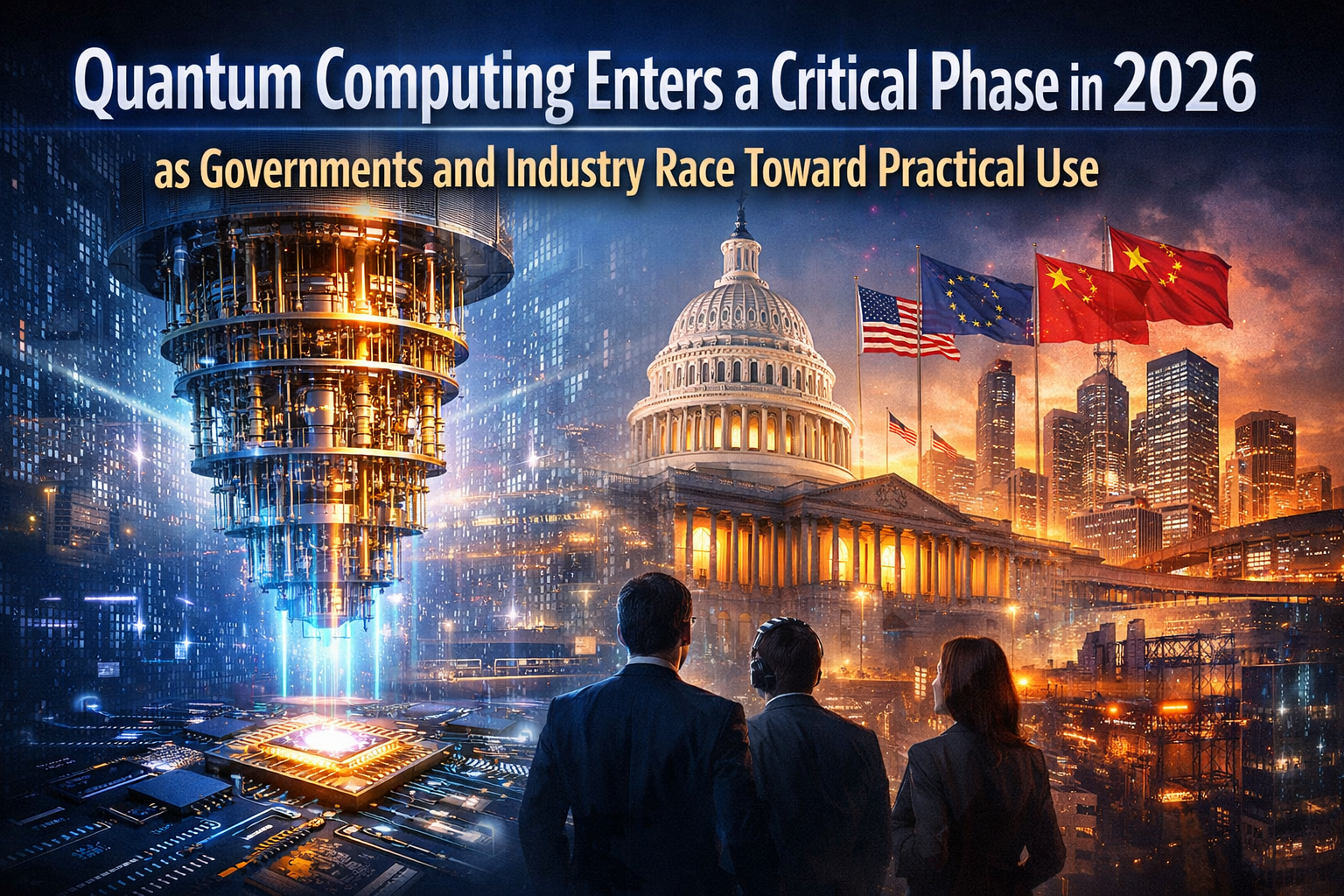
Quantum computing is reaching a pivotal stage in 2026, as governments, technology companies, and research institutions intensify efforts to move the technology from experimental laboratories into real-world applications. Long viewed as a distant breakthrough, quantum computing is now edging closer to practical relevance, raising expectations — and concerns — about its potential to transform industries ranging from cybersecurity to pharmaceuticals.
At its core, quantum computing promises to solve certain problems far faster than classical computers by exploiting the principles of quantum mechanics. Unlike traditional bits, which represent either a zero or a one, quantum bits, or qubits, can exist in multiple states simultaneously. This allows quantum systems to process vast numbers of possibilities at once, theoretically enabling breakthroughs in optimization, simulation, and complex data analysis.
In recent months, several major technology firms and research labs have reported progress in stabilizing qubits and reducing error rates — two of the biggest obstacles to scaling quantum systems. While today’s quantum computers remain limited and highly specialized, experts say the pace of improvement suggests that useful, if narrow, applications could emerge within the next few years.
Governments are investing heavily in the race. The United States, China, and members of the European Union have all expanded national quantum strategies, viewing the technology as both an economic opportunity and a strategic asset. Public funding is flowing into research centers, startup ecosystems, and partnerships with universities, reflecting concern that falling behind could have long-term consequences for competitiveness and security.
Cybersecurity is one of the most discussed implications. Powerful quantum computers could eventually break widely used encryption methods, threatening the security of financial systems, government communications, and personal data. In response, researchers are developing so-called post-quantum cryptography — new encryption techniques designed to withstand quantum attacks. Several governments are already urging institutions to begin preparing for this transition, even though large-scale quantum decryption remains years away.
The private sector is equally active. Technology companies are exploring quantum computing as a service, allowing businesses to experiment with quantum algorithms via cloud platforms. This approach lowers barriers to entry and helps identify practical use cases. Industries such as logistics, finance, and energy are testing quantum-inspired solutions to optimize supply chains, manage risk, and model complex systems more efficiently.
Pharmaceutical and materials science research are seen as especially promising areas. Quantum computers could simulate molecular interactions with unprecedented accuracy, potentially speeding up drug discovery and the development of new materials. Researchers say this could reduce costs and timelines for bringing treatments to market, though most applications are still in early experimental stages.
Despite enthusiasm, significant challenges remain. Quantum systems are extremely sensitive to environmental interference, requiring sophisticated cooling and isolation. Error correction remains a major technical hurdle, and building machines with thousands or millions of reliable qubits is still beyond current capabilities. As a result, some experts caution against overhyping near-term breakthroughs.
Workforce development is another concern. Quantum computing requires expertise in physics, mathematics, computer science, and engineering, yet the global talent pool remains limited. Universities are expanding quantum-related programs, while governments and companies are funding training initiatives to build the next generation of specialists. Without sufficient talent, progress could slow regardless of technological advances.
Ethical and economic questions are also emerging. As with other advanced technologies, there are fears that quantum computing could widen gaps between countries and companies with access to the technology and those without. Policymakers are beginning to discuss frameworks to promote responsible development and prevent misuse, though concrete regulations remain limited.
International collaboration plays a complex role. While scientific cooperation accelerates progress, geopolitical competition is shaping how openly countries share research. Analysts note that quantum technology sits at the intersection of civilian innovation and national security, making trust and transparency harder to maintain. This tension could influence the future direction of global research partnerships.
Public awareness of quantum computing remains relatively low, but that may change as applications become more tangible. Technology leaders and educators are increasingly focused on communicating what quantum computing can — and cannot — do, aiming to manage expectations and avoid unrealistic fears or hype.
Economically, the quantum sector is attracting growing investment. Venture capital funding for quantum startups has increased, though investors remain cautious, aware that returns may take years to materialize. Supporters argue that early investment is essential to secure long-term leadership in a field with transformative potential.
Looking ahead, many experts describe 2026 as a transition year. Quantum computing is not yet ready to replace classical systems, but it is moving beyond pure theory. Hybrid approaches, combining classical and quantum computing, are likely to dominate the near future, offering incremental advantages rather than revolutionary change.
The significance of this moment lies not only in technical progress, but in strategic preparation. Decisions made now — about funding, standards, security, and collaboration — will shape how quantum computing integrates into society. As the technology matures, its impact could rival that of previous computing revolutions.
For now, quantum computing stands at the threshold between promise and practicality. Whether it fulfills its transformative potential will depend on sustained investment, careful governance, and realistic expectations. In 2026, the race is no longer about if quantum computing will matter, but when — and who will be ready when it does.