Satria Rezki Fernanda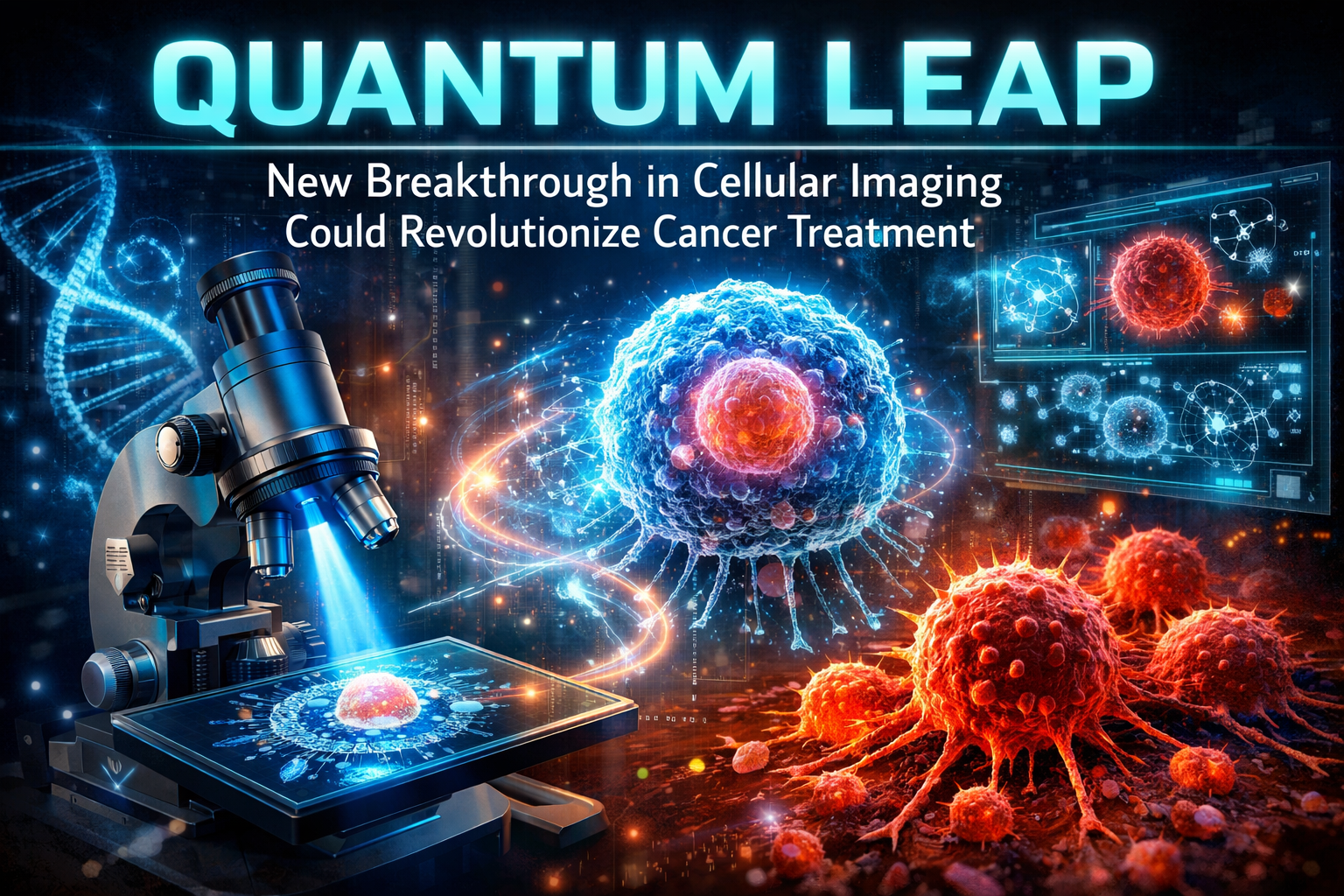
In a move that scientists are hailing as a “new frontier” in medical science, a multinational team of researchers announced on Saturday, December 20, 2025, a successful breakthrough in quantum-enhanced cellular imaging. This new technology, developed through a collaboration between the European Organization for Nuclear Research (CERN) and several leading global universities, allows doctors to observe the metabolic processes of individual cancer cells in real-time with unprecedented precision.
The breakthrough, officially termed “Quantum-Resonance Metabolic Imaging” (QRMI), utilizes subatomic sensors to track chemical reactions within a cell without damaging the delicate biological structures. For decades, the primary challenge in oncology has been the “blind spot” between diagnosis and the actual cellular response to treatment. Traditional MRIs and CT scans provide high-resolution images of tumors, but they often fail to show whether a specific chemotherapy or immunotherapy agent is actually working until weeks or even months into the treatment.
The Science Behind the Breakthrough
The QRMI technology works by deploying “nanodiamonds”—microscopic particles with specific atomic vacancies—into the bloodstream. These nanodiamonds are engineered to gravitate toward high-glucose environments, a hallmark of aggressive cancer cells. Once in place, researchers use quantum sensors to detect the tiny magnetic fields generated by the cell’s internal chemical reactions.
“What we are seeing is essentially a ‘live feed’ of a cell’s life and death,” explained Dr. Elena Vance, the lead physicist on the project. “Previously, we had to wait for a tumor to shrink to know if a drug was effective. Now, within hours of administering a dose, we can see if the cancer cell’s metabolism is slowing down or if it is resisting the medication. This allows for ‘hyper-personalized’ medicine.”
The implications for this are vast. In the current medical landscape, many cancer patients undergo grueling rounds of chemotherapy that may ultimately prove ineffective against their specific genetic makeup. With QRMI, oncologists can theoretically test multiple drugs on a microscopic level within the patient’s own body, selecting the most potent “killer” for that specific cancer before the patient suffers the systemic side effects of a full treatment cycle.
Global Impact and Ethical Considerations
The announcement has sent ripples through the global healthcare market. Shares in major biotechnology firms saw a sharp uptick following the news, while healthcare advocates began calling for immediate discussions on the accessibility of such high-tech diagnostics.
However, the road to widespread clinical use is not without its hurdles. The equipment required to perform QRMI is currently the size of a small room and costs upwards of $15 million per unit. This has raised concerns about a “technological divide” in global health.
“While this is a triumph of human ingenuity, we must ensure it doesn’t become a luxury available only to the wealthiest nations,” said Dr. Amara Okafor, a representative of the World Health Organization. “The challenge now is to miniaturize this technology and make it affordable for hospitals in developing regions where the cancer burden is growing most rapidly.”
Furthermore, the use of “nanodiamonds” and quantum tracking has sparked a debate among bioethicists regarding the long-term effects of synthetic particles remaining in the human body. While the research team insists the particles are biocompatible and naturally excreted by the kidneys within 48 hours, some independent watchdogs are calling for more rigorous, long-term human trials before the technology is cleared for general use by the FDA and EMA.
Looking Toward 2026
The research team plans to begin Phase III clinical trials in early 2026, focusing specifically on hard-to-treat glioblastomas (brain tumors) and pancreatic cancer. Because these cancers are often diagnosed late and are notoriously resistant to standard treatments, they represent the most urgent proving ground for the new quantum technology.
In addition to oncology, researchers believe QRMI could have applications in neurology, particularly in the early detection of Alzheimer’s and Parkinson’s diseases. By monitoring the metabolic “misfiring” of neurons long before physical symptoms appear, doctors might finally be able to intervene in the degenerative process during its infancy.
As the sun sets on 2025, the scientific community is looking forward to a year where the line between “impossible” and “standard care” continues to blur. If QRMI lives up to its promise, the “War on Cancer” may finally have the high-definition radar it has needed for over half a century.