Satria Rezki Fernanda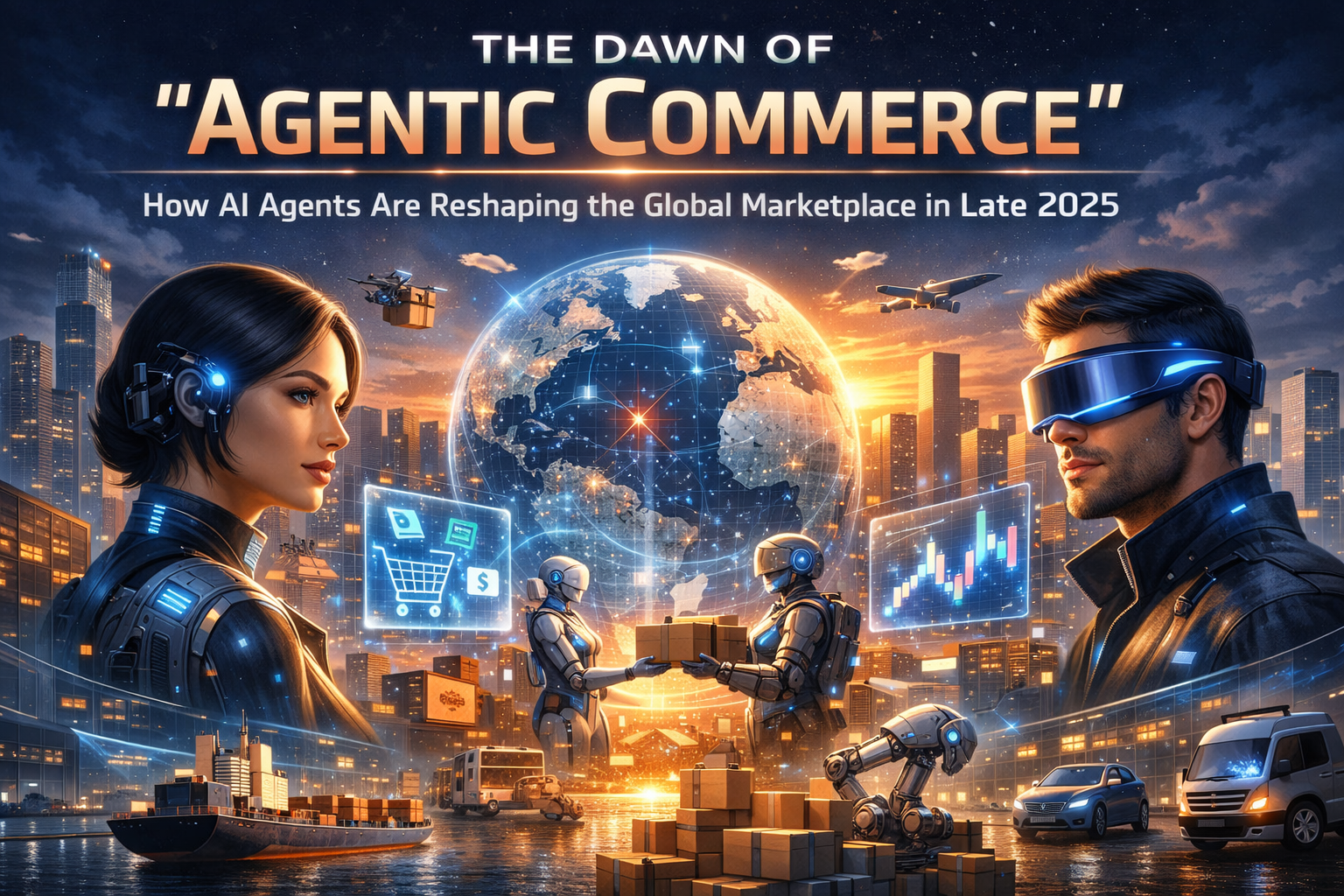
As 2025 draws to a close, the global retail and digital landscape is witnessing its most significant shift since the invention of the smartphone. The rise of “Agentic AI”—autonomous artificial intelligence systems capable of reasoning, planning, and executing complex tasks—has officially moved from experimental labs into the hands of hundreds of millions of consumers, fundamentally altering how the world shops, travels, and manages finances.
From Chatbots to Autonomous Agents
For the past two years, the world was captivated by Large Language Models (LLMs) that could write essays or generate images. However, December 2025 marks the era of the “Agent.” Unlike previous iterations that merely provided information, these new systems, such as Google’s latest Gemini 3 Deep Research and OpenAI’s GPT-5.2 “Garlic” series, are designed to act on a user’s behalf.
“We are moving from a ‘search-and-click’ internet to an ‘intent-and-execute’ ecosystem,” says Dr. Aris Thorne, a leading AI researcher at the London Institute of Technology. “You no longer spend three hours comparing flight prices, hotel proximity, and credit card rewards. You simply tell your agent your budget and preferences, and it negotiates the deal and completes the transaction while you sleep.”
The Economic Ripple Effect
This technological leap is not just a convenience; it is a massive economic driver. Major financial institutions like Mastercard and Visa have recently launched “Agent-Pay” frameworks—secure protocols that allow AI agents to use digital wallets within strict, user-defined guardrails.
In the United States and Europe, early data from December holiday shopping suggests that nearly 18% of all online transactions were initiated or completed by AI agents. This “Agentic Commerce” has forced retailers to abandon traditional SEO (Search Engine Optimization) in favor of AIO (AI Optimization). Businesses are now racing to make their data “readable” for AI bots rather than human eyes, ensuring their products are the ones selected by the autonomous shoppers.
Ethical Concerns and the “Bot-on-Bot” Economy
However, the rapid adoption of agentic technology has not been without controversy. Regulators in Brussels and Washington D.C. are currently debating the legalities of “Bot-on-Bot” price wars. In several instances this month, sophisticated trading agents used by rival retailers engaged in high-frequency price undercutting, leading to flash crashes in certain commodity markets.
Moreover, the issue of AI Sovereignty has become a central theme of International Human Solidarity Day (observed on December 20). Civil society groups are raising alarms about the “digital divide.” While wealthy nations are seeing productivity gains from AI agents, developing economies—which are currently facing slower growth rates of around 3.8%—risk being left behind if they cannot access the high-cost computing power required to run these advanced models.
Global Investment and the Road Ahead
In response, countries like Indonesia have taken bold steps to secure their place in this new era. Earlier this week, Indonesia’s Ministry of Communication and Digital Affairs announced a new National AI Roadmap, aiming to train 100,000 AI specialists annually. By inviting global investors to capitalize on its semiconductor resources, the nation hopes to transition from a consumer of AI to a sovereign producer.
Looking forward to 2026, the focus is expected to shift toward Multi-Agent Systems. Instead of one AI doing one task, “swarms” of specialized agents will work together to manage entire supply chains or coordinate global disaster relief efforts.
The Human Element
Despite the automation, experts insist that human oversight remains the “kill switch” for the global economy. As we navigate the complexities of 2026, the challenge will be to ensure that these agents remain tools for human empowerment rather than sources of systemic instability.
“The AI agent is the ultimate personal assistant,” concludes Dr. Thorne. “But the responsibility for the final purchase, the final flight, and the final moral choice still rests firmly with us.”