Satria Rezki Fernanda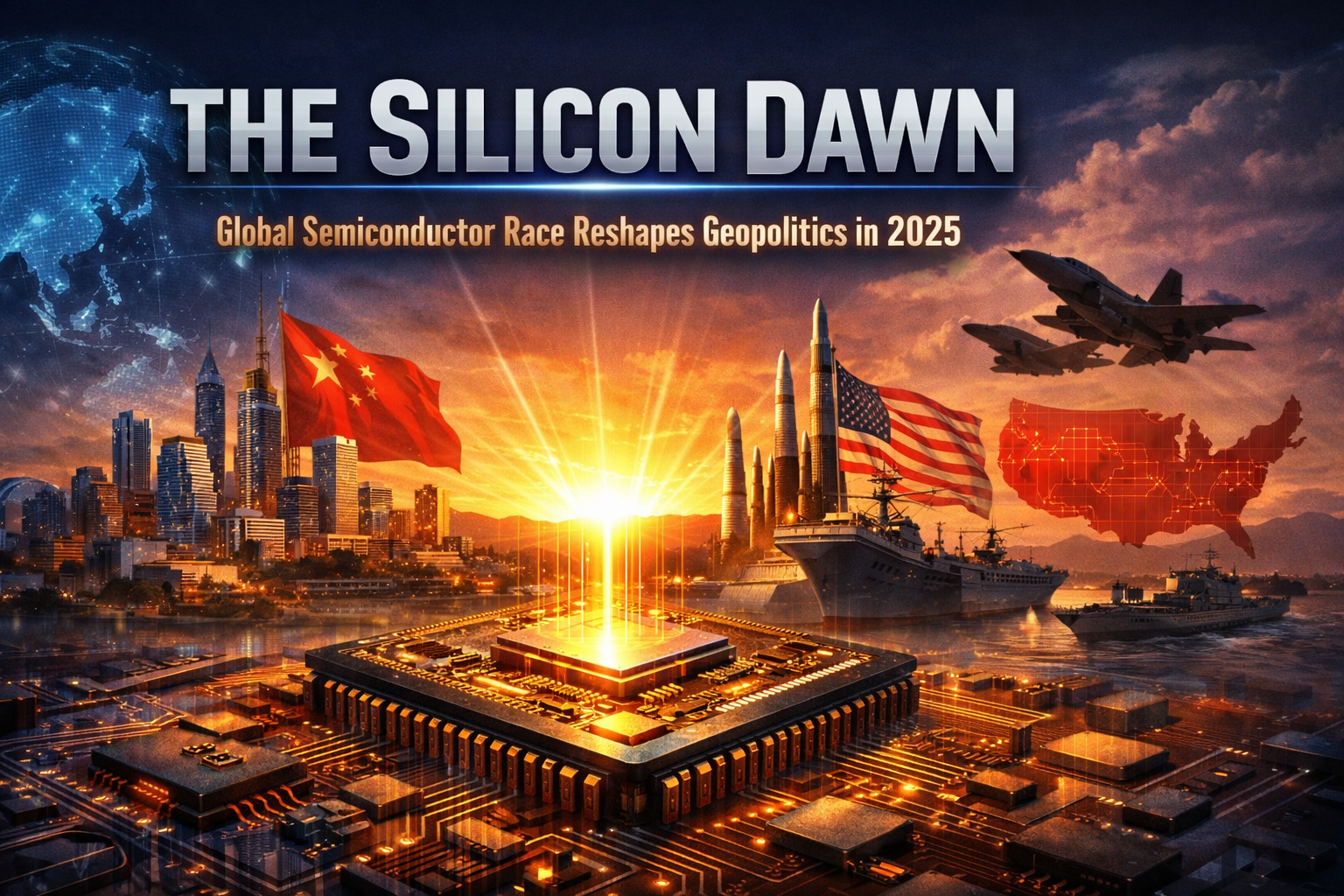
The global landscape of power is no longer being defined solely by oil reserves or military hardware, but by the microscopic architecture of the semiconductor. As of late 2025, the “Chip Wars” have entered a sophisticated new phase, moving beyond simple supply chain disruptions into a full-scale industrial arms race that is redrawing the map of international alliances and economic superiority.
The Great Diversification
For decades, the world’s reliance on a handful of manufacturing hubs in East Asia—most notably Taiwan and South Korea—was seen as an efficient byproduct of globalization. However, the fragility of this model, exposed by the pandemic and heightened by recent geopolitical tensions, has forced a radical pivot.
In a landmark summit held in Brussels this week, leaders from the European Union and the United States announced the Transatlantic Silicon Accord. This agreement aims to synchronize subsidy programs, ensuring that the billions of dollars being poured into domestic chip manufacturing do not lead to a “race to the bottom” or a global oversupply of legacy chips. Instead, the focus has shifted toward 2-nanometer (2nm) nodes and specialized AI processors.
“We are entering an era where computing power is the new currency of sovereignty,” remarked Elena Vance, the EU Commissioner for Digital Excellence. “To be dependent on a single geographic point for the brains of our cars, our hospitals, and our defense systems is a risk we can no longer afford to take.”
The Rise of Regional Hubs
The United States, fueled by the continued momentum of the CHIPS and Science Act, has seen the official opening of three “mega-fabs” in Arizona and Ohio this year. These facilities are not just factories; they are ecosystems. They have attracted thousands of high-skilled workers from across the globe, sparking a mini-economic boom in the American Midwest.
However, the West is not the only player seeking autonomy. China, despite facing stringent export controls on high-end extreme ultraviolet (EUV) lithography machines, has made surprising strides in chiplet technology. By stacking older-generation chips in innovative 3D architectures, Chinese engineers have managed to achieve performance levels that rival more advanced single-die processors. This “workaround” strategy has allowed Beijing to maintain its lead in the global electric vehicle (EV) market, where raw processing power is often less critical than integrated power management.
Meanwhile, India and Vietnam have emerged as the new “back-end” champions. While they aren’t yet competing in the cutting-edge logic space, they have captured over 40% of the global assembly, testing, and packaging (ATP) market. This shift has moved thousands of jobs away from traditional centers, creating a more distributed—and perhaps more resilient—global supply chain.
The AI Catalyst
The primary driver behind this frantic expansion is the insatiable demand for Artificial Intelligence. The generative AI boom of 2023-2024 has matured into an “Industrial AI” era. Every major corporation now requires proprietary hardware to run localized LLMs (Large Language Models) to ensure data privacy and operational speed.
The leading chip designer, NVIDIA, alongside competitors like AMD and burgeoning RISC-V startups, has shifted its focus toward “Energy-Efficient Inference.” As data centers begin to consume significant percentages of national power grids, the race is no longer just about how fast a chip can think, but how little “juice” it needs to do so. This has led to a surge in investment in Silicon Carbide (SiC) and Gallium Nitride (GaN) technologies, which are essential for the next generation of power electronics.
Environmental and Ethical Hurdles
Despite the economic optimism, the semiconductor expansion faces a looming shadow: the environmental cost. A single large-scale fabrication plant can consume millions of gallons of water per day and requires a massive, stable power supply.
In Arizona, local activists have raised concerns about groundwater depletion, leading to a new wave of “Circular Fab” initiatives. These projects aim to recycle 98% of the water used in the manufacturing process. Furthermore, the ethical sourcing of raw materials—such as neon gas from Eastern Europe and rare earth elements from Africa—remains a sticking point. The “Green Chip” certification is expected to become a mandatory requirement for any company seeking government subsidies by 2026.
The Road Ahead
As we look toward 2026, the industry faces a paradoxical challenge. While there is a desperate need for more chips, the cost of building these facilities has skyrocketed. A modern 2nm-capable plant now costs upwards of $30 billion, a price tag that only a few nations and a handful of corporations can afford.
The risk of a “bifurcated” tech world is real. If the West and the East continue to develop incompatible hardware ecosystems, the seamless global internet and shared technological standards of the last thirty years could begin to fracture.
“We are at a crossroads,” says Dr. Aris Thorne, a senior analyst at Global Tech Insights. “The next two years will determine if the semiconductor race leads to a more resilient, distributed world, or if it creates a digital ‘Iron Curtain’ that stifles innovation for decades.
“For now, the cranes are up, the silicon is flowing, and the world waits to see who will win the race to define the intelligence of the future.